




If you use Opera browser, you might have noticed something: new extensions take forever to arrive, and existing ones stop getting updated. Your favorite tools languish in the store unchanged for months or years.
Meanwhile, in Chrome and Firefox, new features and security patches roll out weekly.
This isn’t coincidence. Opera’s extension marketplace has a critical problem that’s pushing developers away—and if you use Opera, you should understand what’s happening.
The Numbers Tell the Story
- Chrome Web Store: 111,933 extensions. Average review time: under 24 hours.
- Firefox Add-ons: ~30,000 extensions. Average review time: under 10 days.
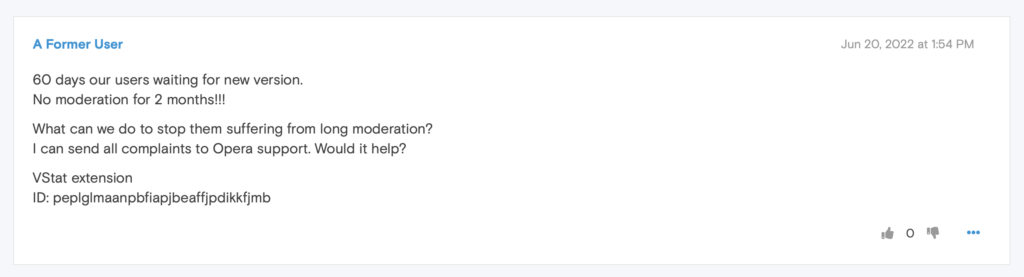
- Opera Addons: 2,190 extensions. Average review time: 3-9 months.
Let that sink in. Opera has 50 times fewer extensions than Chrome, yet takes 12-36 times longer to review them.
Of Opera’s 2,190 extensions, roughly 60-80% are abandoned—last updated a year ago or more. Only about 500 extensions receive regular updates.
This isn’t a platform that’s thriving. It’s one that’s stagnating.
Why This Happens: The Queue Excuse That Doesn’t Hold Up
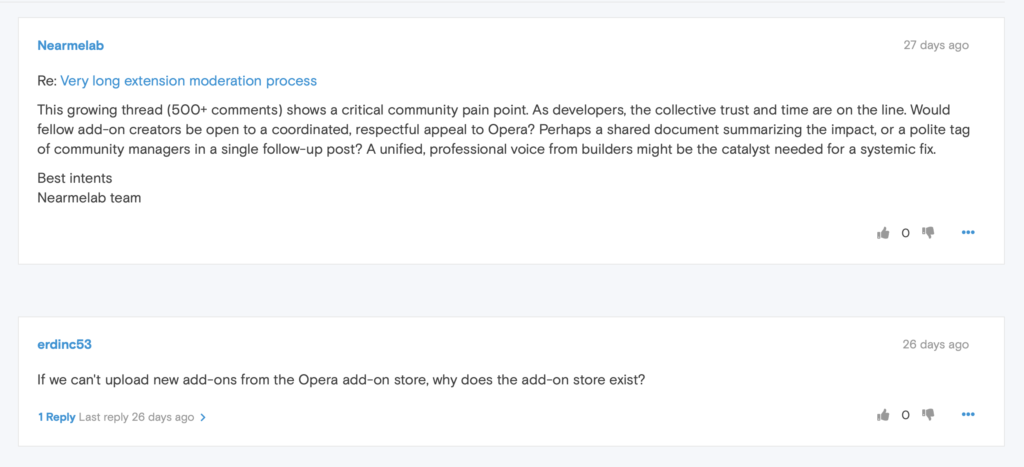
When developers complain about 3-month waits, Opera’s response is always the same: “We understand it can feel slow. We host thousands of extension.”

But this explanation doesn’t hold up to scrutiny—not because Opera is claiming an unreasonable workload, but because the actual workload is deliberately being misrepresented.
Yes, Opera hosts 2,190 extensions. But 60-80% of them are completely abandoned—last updated a year ago or more. Developers aren’t updating them. Users aren’t installing them. They’re digital graveyards taking up space in the store.
You don’t need statistics to verify this. Spend five minutes browsing Opera Addons. Scroll through a few pages of any category. You’ll see extension after extension with update dates from 2022, 2021, 2020. “Last updated 3 years ago.” “Last updated 5 years ago.” Extensions with three-star reviews and one user. Extensions that haven’t been touched since they were published.
The actual number of actively maintained extensions that require moderation is somewhere around 500 at most. Maybe less.
So when Opera says “we host thousands of extensions,” they’re technically correct but deliberately misleading. They’re not saying “we actively moderate thousands of submissions.” They’re saying “we have thousands of listings, most of which nobody touches.”
The real problem isn’t volume. It’s that Opera processes a small, manageable stream of new submissions and updates—perhaps a few hundred per month—but takes 3-9 months to review them.
Chrome processes 111,933 extensions. Firefox processes 30,000. Opera processes 2,190. Yet Opera’s review time is the slowest by far.
This explanation falls apart under scrutiny.
That’s not a resource problem proportional to workload. It’s a management problem.

722.1K views on the topic, incredible.
Even if Opera’s review queue contains only new submissions and updates—perhaps a few hundred per month—the processing speed remains inexplicably slow. Chrome reviews similar volumes in days. Opera takes months. When new extensions wait 3-9 months while identical submissions are approved in Chrome within 24 hours, the problem isn’t queue size. It’s processing speed per item.
The real reason? Opera hasn’t invested in solving the problem.
Chrome and Firefox use automated systems to handle 80-90% of reviews. Malware detection, permission scanning, code analysis—all automated. Humans only intervene when something is flagged.
Opera appears to use 100% manual review with no automation. No wonder it’s slow.
In 2018, Opera promised to implement “auto-moderation” to fix this exact problem. As of 2026—eight years later—the problem still exists.
That’s not a queue problem. That’s negligence.
What This Means for Opera Users
If you’re an Opera user, this affects you directly:
Slower Security Updates: When a vulnerability is discovered in a popular extension, Chrome users get a fix within hours. Opera users wait weeks or months—if they get a fix at all.
Fewer New Tools: Developers increasingly skip Opera entirely. Why spend time getting approval for 2,190 users when Chrome has 2 billion? New extensions simply don’t arrive.
Abandoned Tools: When developers update their extension on Chrome (weekly) and Firefox (weekly), they often forget to resubmit to Opera. The Opera version stagnates.
Lower Quality: Without competition from new tools, the existing extensions have less pressure to improve.
The Developer Exodus Is Real
Developers are leaving Opera. A 2021 Reddit post captured the sentiment: “Chrome, Edge, and Firefox approve instantly. There’s no reason to publish on Opera. Users can install from Chrome Web Store directly in Opera anyway.”
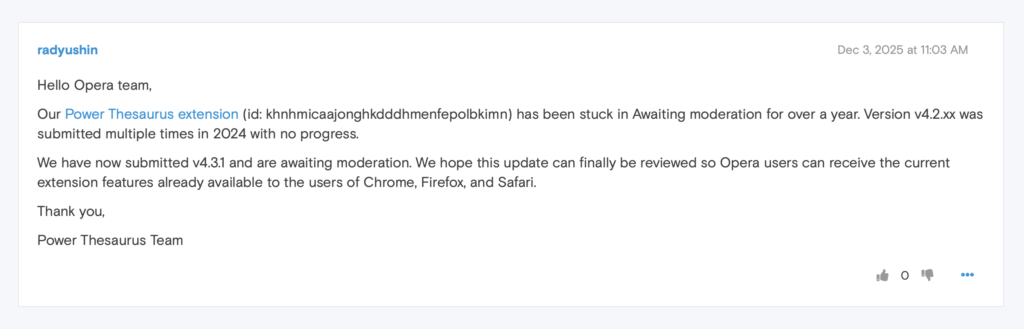
A 2025 forum post showed a developer who waited 8 months, received no communication, and deleted their submission: “I’m not waiting anymore. I’ve got a life.”
This creates a downward spiral:
- Developers wait months for reviews
- Developers give up and stop publishing on Opera
- Opera’s extension library shrinks
- Users see fewer options, so fewer use Opera
- Fewer users means fewer incentives for developers
Opera is caught in a death spiral of its own making.
The Manifest V2 Inconsistency: The Smoking Gun
The most telling evidence of Opera’s dysfunction is its selective rule enforcement.
In late 2025, Opera announced that Manifest V2 extensions (an older technical standard) would no longer be accepted and must migrate to Manifest V3.
Yet a developer who documented the situation found 17 major published extensions on Opera that still use Manifest V2—AdGuard, Instant Translate, Screen Recorder, VPN extensions, and others.
When they asked Opera why these extensions were exempt, the answer was vague: “They’re in the queue.”
This reveals the truth: Opera isn’t managing the platform systematically. It’s managing it ad-hoc, reacting to whoever complains loudest, enforcing rules inconsistently.
A well-managed platform would have a clear migration timeline and systematic enforcement. Opera just has a backlog and confusion.
Why Opera Still Exists (But Shouldn’t Be Your First Choice)
Opera has about 2-3% global browser market share, with particular strength in Africa and other emerging markets.
It’s owned 69-72% by Kunlun Tech, a Chinese company. This ownership structure may explain why extension moderation isn’t a priority—resources are allocated to other initiatives (VPN services, crypto wallets, mobile apps).
For Opera’s core user base in emerging markets, browser stability matters more than extension ecosystem. But for anyone in developed markets with expectations around tools and customization, Opera is increasingly a non-starter.
What This Means for Your Browser Choices
If you’re currently using Opera: Consider switching to Chrome or Firefox if you rely on extensions. You’ll get:
- Faster access to new tools
- More security-focused maintenance
- More extensions to choose from
- Faster security patches
If you’re choosing a browser: Don’t choose Opera for its extension ecosystem. You can use Opera’s built-in features (built-in VPN, ad blocker, battery saver), but for tools, you’re better served by Chrome or Firefox.
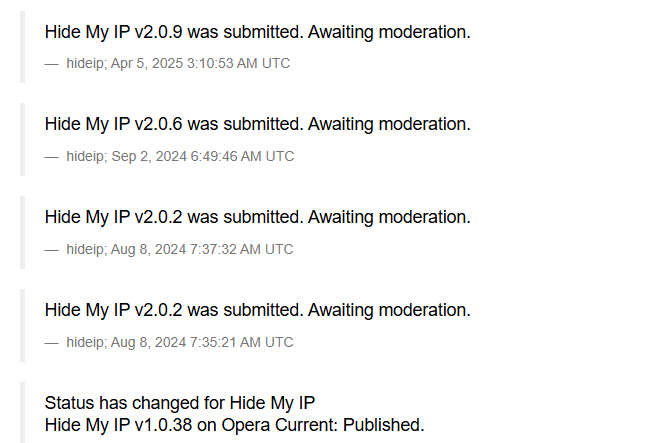
It is now 2025 and still there seems to be quite a delay with Opera moderating add-ons. Waiting nearly 8 months for a moderator. Google only takes a day or two for approvals, but not the case with Opera even if the extension code is nearly identical to the Chrome version.
HideIP
If you’re on the fence: Firefox is the privacy-conscious alternative. Chrome is the standard with the most extensions. Opera is increasingly a legacy choice.
Thoughts
Opera Addons isn’t slow because it’s handling millions of extensions. It’s slow because Opera hasn’t invested in making it fast.
Seven years of unfixed promises and a marketplace with 80% abandoned extensions tell you everything you need to know about Opera’s priorities.
If Opera wanted to solve this problem, it could:
- Hire 2-3 more reviewers (trivial cost)
- Implement basic automation (solved problem, well-documented)
- Publish transparent metrics and timelines (free to do)
The fact that none of this has happened suggests Opera has accepted that extension moderation is a legacy feature that doesn’t matter to the business.
For you as a user, that means: You’re better off elsewhere.