



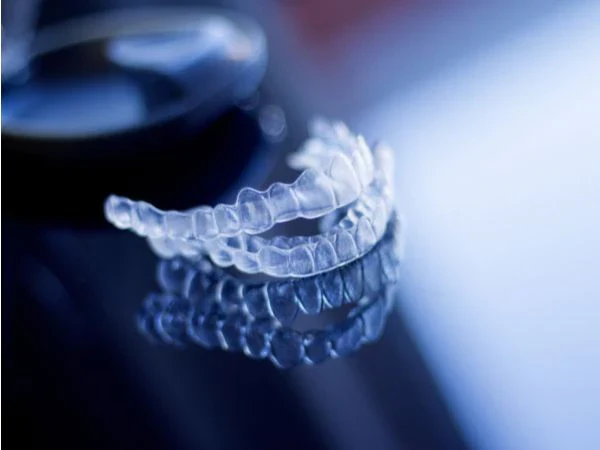
The promise is tempting: straighten your teeth without anyone knowing, while you sleep, and enjoy full daytime freedom. Night-only clear aligners sound like the perfect solution for busy professionals, content creators, and anyone self-conscious about wearing orthodontic appliances. But the science tells a more nuanced story. Here’s what you need to know before committing to nighttime-only treatment.
How Clear Aligners Work – The Biology Behind Tooth Movement
The 22-Hour Gold Standard
Traditional clear aligner systems (like Invisalign) require 20–22 hours of daily wear for a reason grounded in bone remodeling biology. This isn’t arbitrary—it’s based on decades of research into how teeth actually move.
When you apply consistent force to a tooth, a complex cellular cascade unfolds:
Phase 1: Initial Response (0–6 hours)
Blood flow around the tooth root increases. Specialized cells in the periodontal ligament respond to mechanical stress, releasing chemical signals.
Phase 2: Cellular Activation (6–18 hours)
Osteoclast cells (bone-breaking cells) become fully activated on the pressure side of the tooth root. Simultaneously, osteoblasts (bone-building cells) prepare to construct new bone on the tension side.
Phase 3: Sustained Remodeling (18–24 hours)
The final phase requires sustained force to maintain cellular activity initiated earlier. Interrupting force during this phase can slow remodeling significantly or even reverse it.
The Critical Window: Research using advanced pressure-sensing technology has mapped exactly how aligner forces change throughout the day. The data is clear: while the first 12 hours provide dramatic force application, the final 6–10 hours of daily wear are essential for maintaining the biological processes started earlier. Skip those hours, and the remodeling process stalls.
What Happens When You Wear Aligners Less?
The consequences of insufficient wear time are well-documented in clinical trials:
- 16–18 hours daily: Treatment outcomes are statistically significantly different from 20+ hours. Teeth move, but inconsistently
- 12–16 hours daily: Even more dramatic delays. A randomized controlled trial comparing 12-hour vs. 22-hour wear showed that the 12-hour group achieved adequate correction of upper-arch crowding but showed significantly less effective correction of lower-arch misalignment
- Less than 12 hours daily: In many cases, results are statistically indistinguishable from no treatment at all
Why? When aligners are removed for extended periods, teeth start to shift back toward their original positions. The longer the aligner is out, the more rebound occurs. This constant shifting-and-re-shifting doesn’t just slow treatment—it places additional stress on the tooth root and periodontal ligament, increasing the risk of damage.
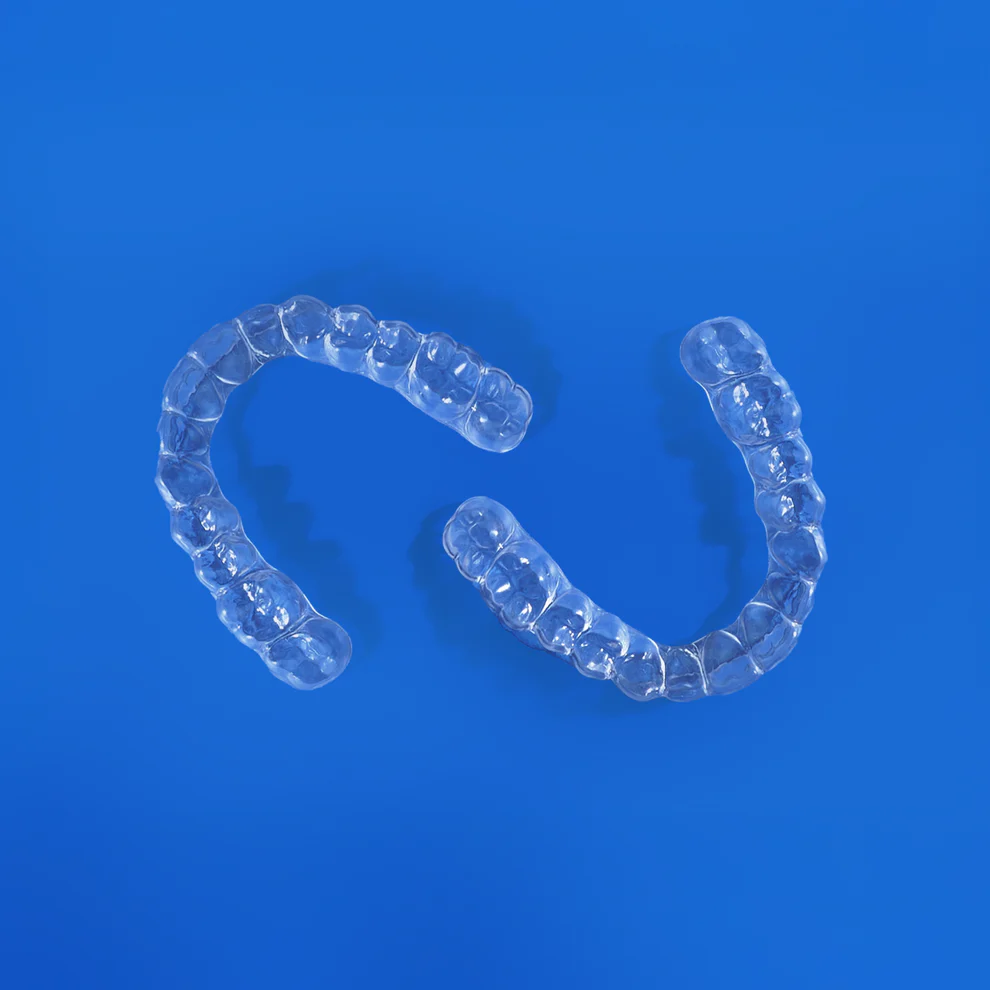
Night Teeth Straightening Aligners
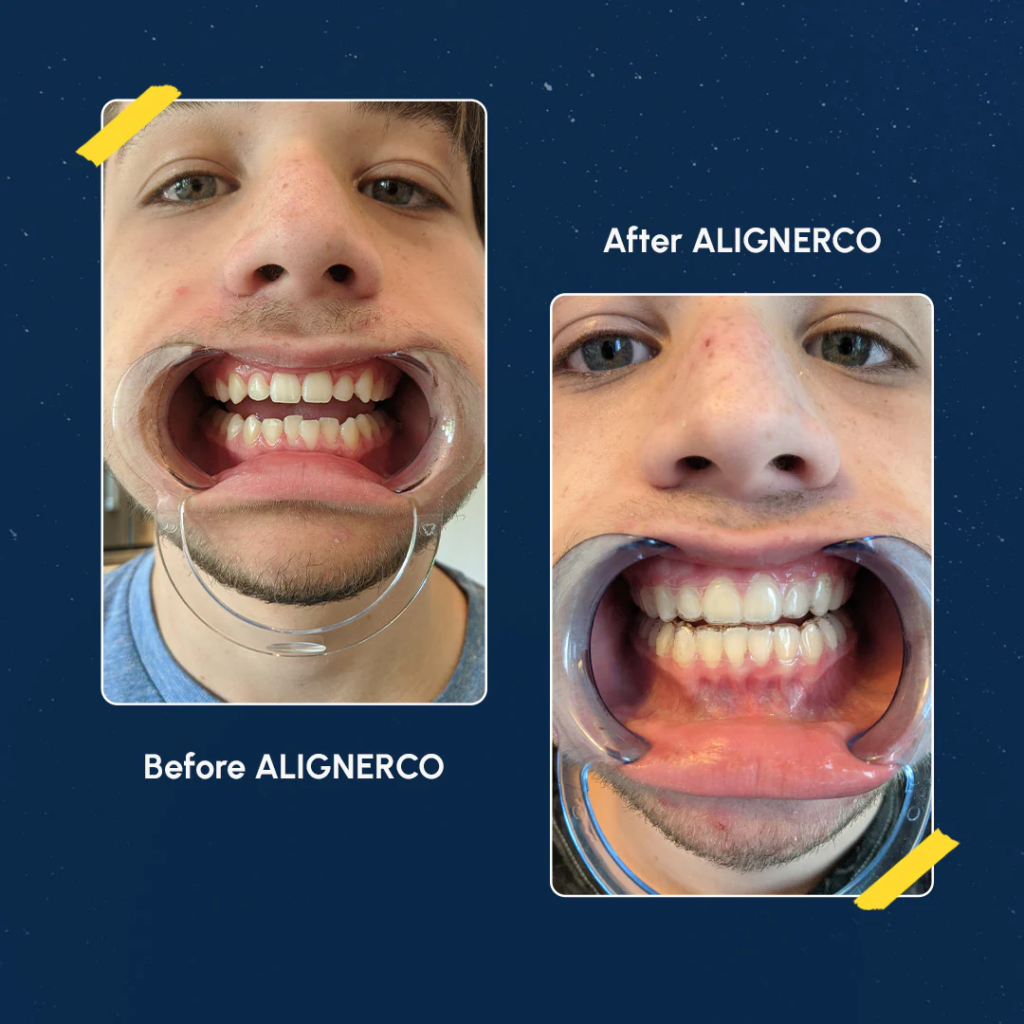
Straighten your teeth while you sleep with AlignerCo NightOnly clear aligners. Discreet 8-hour nightly treatment, visible results in 6-10 months. Affordable, easy, effective.
Night-Only Aligners – What The Marketing Says vs. What Science Shows
The Appeal
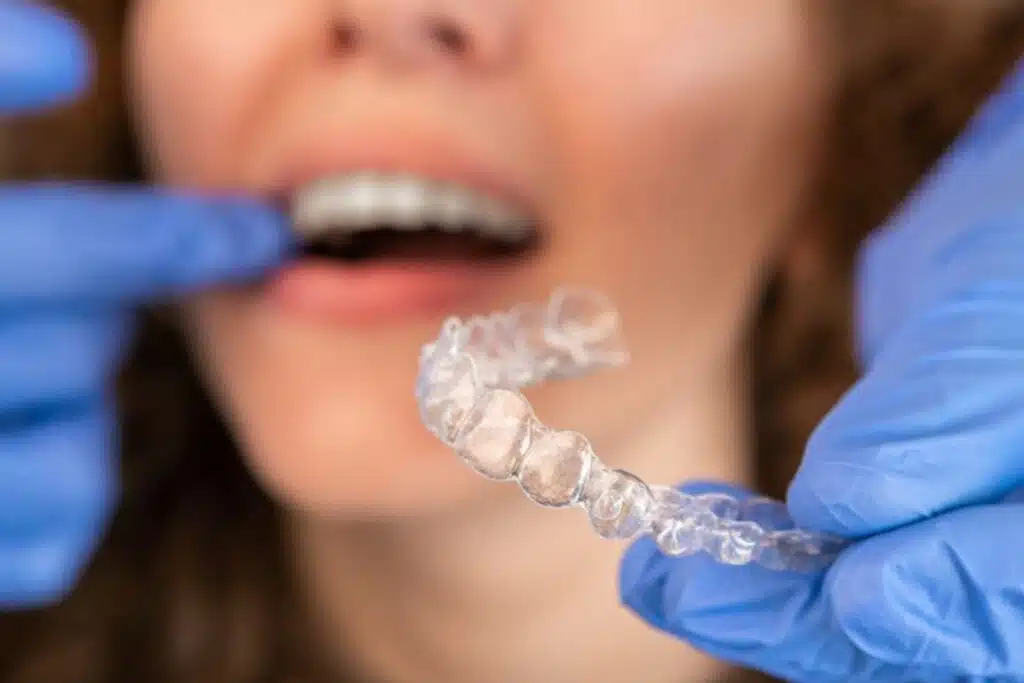
Night-only clear aligners (typically 8–10 hours of wear per night) are marketed with compelling promises:
- Social freedom: No one sees your aligners during work, dates, or public events
- Faster lifestyle integration: You’re free 14+ hours daily
- Lower cost (sometimes): Fewer aligner trays needed if treatment takes longer
Companies make different claims about timeline and effectiveness:
- Some claim treatment takes 8–12 months at 8 hours/day
- Others claim 4–6 months with special “harder material” trays + a vibrating device for “micro-pulses”
- Still others simply double the standard wear schedule (wear each tray for 2 weeks instead of 1)
What the Science Actually Says
Clinical reality: Night-only treatment works—but only for very mild cases and with substantially longer timelines.
A 2025 study examining 12-hour wear (half the standard) found that it can achieve “clinically adequate alignment in the maxilla [upper arch] in cases of very mild crowding” but correction of lower-arch issues was “significantly more efficient with the traditional 22-hour protocol“.
If 12-hour wear is noticeably less effective than 22-hour wear, 8–10 hour wear is far less effective still.
The wear-time reality:
| Daily Wear | Best For | Treatment Duration | Risk Profile |
|---|---|---|---|
| 20–22 hours | All complexity levels | 6–18 months | Minimal |
| 12–16 hours | Mild crowding/spacing | 12–20 months | Moderate |
| 8–10 hours (night-only) | Extreme mild cases only | 12–24+ months | High |
The Problem with Interrupted Force
Here’s the biological issue orthodontists emphasize: teeth respond to continuous pressure, not intermittent pressure.
When you remove aligners for 14+ hours daily:
- Teeth rebound: Cells that were being activated stop receiving signals. Bone remodeling pauses
- Inconsistent pressure distribution: The remaining 8–10 hours of wear creates uneven force patterns
- Higher relapse risk: Incomplete tooth movements are more likely to reverse after treatment
- Root stress: The constant micro-shifting places repeated stress on the periodontal ligament and root surface
When Night-Only Aligners Might Work (And When They’ll Disappoint)
Who Is Actually a Candidate?
Night-only aligners are realistic only for patients with:
- Minimal spacing (1–3mm gaps) between upper front teeth
- Very mild crowding (Little’s Index < 5mm—essentially just cosmetic tweaks)
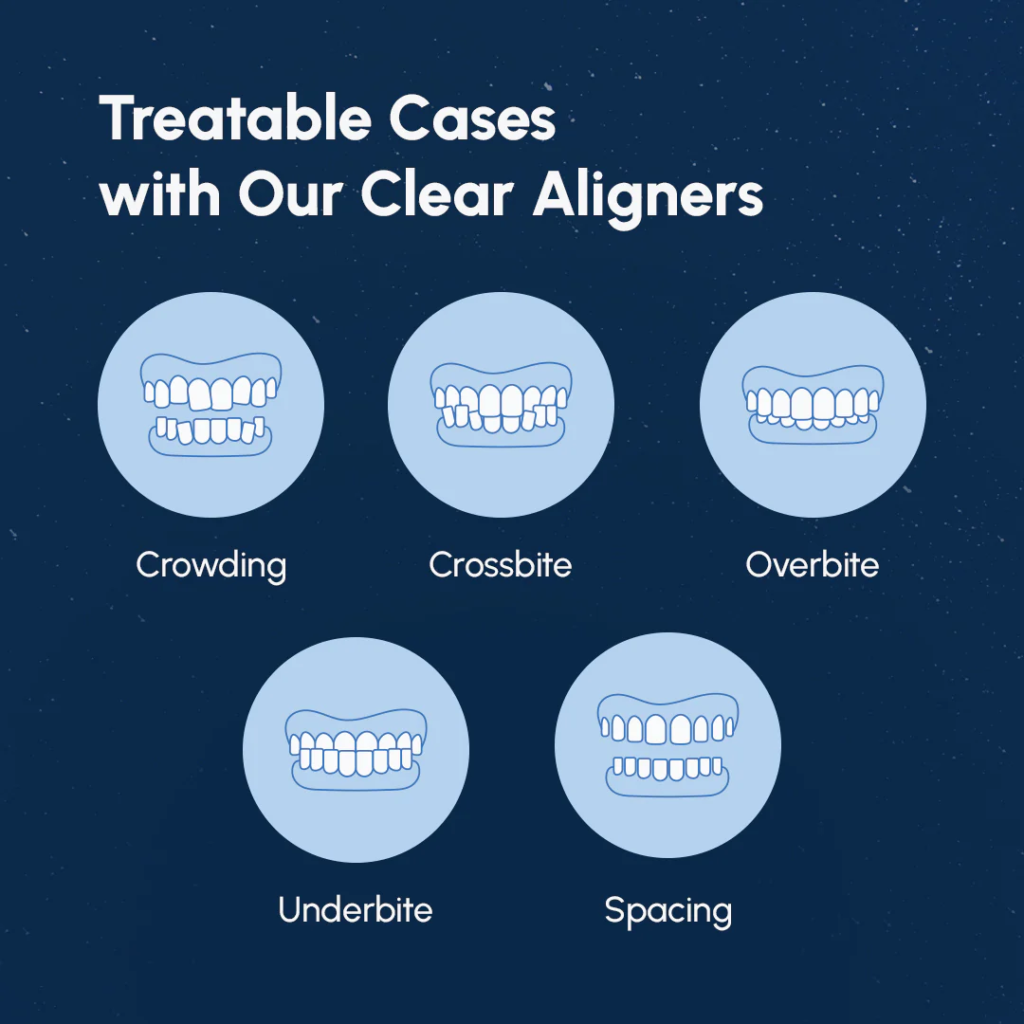
- No bite issues (anterior open bite, crossbite, overbite, or overjet problems require full-time wear)
- Realistic timeline expectations (willing to wait 12–24 months or longer)
Night Teeth Straightening Aligners
Straighten your teeth while you sleep with AlignerCo NightOnly clear aligners. Discreet 8-hour nightly treatment, visible results in 6-10 months. Affordable, easy, effective.
Who Should Avoid Night-Only Aligners
If you have:
- Moderate to severe crowding or spacing
- Bite problems (underbite, overbite, crossbite, open bite)
- Rotated teeth that need significant repositioning
- Lower-arch misalignment (night-only wear is especially ineffective here)
- A desire for predictable, fast results
…then night-only treatment will likely disappoint you, extend your timeline dramatically, or require refinements/additional trays that negate the time and cost savings.
Understanding Night-Only Options
For users specifically seeking night-only treatment, night-only clear aligners represent an affordable entry point into at-home aligner treatment.
How night-only aligners typically work:
- Wear time: 8 hours nightly (typically during sleep)
- Treatment timeline: 6–10 months for qualifying mild cases
- Monitoring: Remote video check-ins and app-based progress tracking
- Ideal for: Very mild spacing, minor cosmetic adjustments, people who strongly prefer daytime freedom
The honest reality:
What users typically report: good experiences with discretion and ease of the routine for cosmetic, very-mild-case users. For these narrow cases, the convenience value is genuine.
The trade-offs:
- Treatment takes 2–3x longer than full-time wear (6–10 months vs. 3–4 months for the same mild case)
- If your case is more complex than initially assessed, progress stalls and you may need refinements
- You’re dependent on nightly compliance—missed nights = extended timeline
- You cannot correct bite problems with night-only wear
When night-only makes sense:
You have 1–3mm of spacing between upper front teeth, perfect bite already, you’re in no rush, you prioritize daytime discretion over speed, and you want the lowest-cost clear aligner option. In this narrow window, night-only treatment could work well.
When night-only will disappoint:
You hope night-only wear will fix a moderate crowding problem, correct your bite, or somehow move teeth faster. It won’t. You’ll be frustrated within 3–4 months when progress is invisible.
Night Teeth Straightening Aligners
Straighten your teeth while you sleep with AlignerCo NightOnly clear aligners. Discreet 8-hour nightly treatment, visible results in 6-10 months. Affordable, easy, effective.
Comparing Your Options
Night-Only vs. Full-Time Clear Aligners: A Realistic Comparison
| Factor | Night-Only (8–10 hrs) | Full-Time (20–22 hrs) |
|---|---|---|
| Daytime visibility | Invisible | Requires brief removal (meals, brushing) |
| Treatment speed | Slow: 12–24 months | Fast: 6–18 months |
| Effectiveness | Only mild cases | Mild to complex cases |
| Bite correction | No | Yes |
| Cost (for mild cases) | ~$1,000–$1,500 | ~$1,500–$3,000+ |
| Risk of relapse | Higher (incomplete movements) | Lower (complete tooth positioning) |
| Professional supervision | Remote (app-based) | Remote or in-office |
| Best for | Cosmetic spacing; extreme discretion | Serious alignment; results certainty |
Night-Only vs. Traditional Braces
Interestingly, night-only aligners are less effective than traditional braces at ANY frequency. Orthodontists have observed significant dental changes in patients wearing sleep apnea appliances (similar force application) for just 7–8 hours per night, but only because those devices are worn every single night without fail, and the force is specialized. General-use night-only aligners lack that consistency and specialized force profile.
What Dentists and Orthodontists Actually Think
The Professional Consensus
Dr. Brandon Murphy (dental expert): “Aligners can indeed work while you sleep, but they cannot do all the work in that limited timeframe. Overnight-only solutions often lead to frustration because they do not deliver the same results as full-time wear”.
Research-backed view: The American Association of Orthodontists’ data shows that compliance with 20–22-hour wear correlates directly with treatment success. Reduced wear time = reduced effectiveness, period.
Common orthodontist concern: “Nearly invisible nighttime aligners offer no clear benefit over regular aligners. Instead, they prolong treatment time and increase the risk of root damage”.
The professional view isn’t judgmental—it’s practical. If you have the right case (truly mild, cosmetic-only), night-only wear is workable but slow. If you have anything more complex, it’s a false economy.
Part 7: Making the Decision – Practical Questions to Ask Yourself
Before choosing night-only aligners, honestly answer these:
- Is my case truly mild? (Spacing <3mm, perfect bite, minimal crowding?)
- Am I prepared to wait 12–24 months? (Night-only timelines are often double full-time treatment)
- Do I have perfect nightly compliance? (Missing nights extends timeline further)
- Is daytime discretion worth the trade-offs? (Social comfort vs. speed/results certainty)
- Will my partner/family support 6–24 months of very slow progress? (Seeing almost no change month-to-month is psychologically harder than the daily micro-changes of full-time wear)
- Do I have a bite problem? (If yes: night-only won’t fix it, regardless of brand)
If you answered “yes” to 1–4 and “no” to 5–6: Night-only aligners might actually be right for you.
If you answered “no” to 1, or “yes” to 5–6: Full-time clear aligners (or traditional orthodontics) are the better choice.
Timeline Expectations – The Reality
Full-Time Clear Aligner Treatment (20–22 hrs/day)
- Mild spacing: 3–6 months
- Mild-to-moderate crowding: 6–12 months
- Moderate complex cases: 12–18 months
Night-Only Clear Aligner Treatment (8–10 hrs/day)
- Mild spacing: 6–10 months
- “Mild-to-moderate” crowding: Often doesn’t work well; if it does, 12–24 months
Real-world perspective: A 6-month full-time treatment that delivers a beautiful result beats an 18-month night-only treatment that delivers a mediocre result.
Cost Comparison (What You’re Actually Paying For)
| Treatment | Cost | Cost Per Month | Time to Results | Cost Per Month Per Year |
|---|---|---|---|---|
| Night-only aligners | ~$1,200 | ~$120 | 10 months | $1,440/year equivalent |
| Full-time aligners | ~$1,200 | ~$200 | 4–6 months | $2,400–3,600/year equivalent |
| Invisalign (full-time) | ~$3,000–$8,000 | ~$250–$333 | 6–18 months | $3,000–$4,000/year |
| Traditional Braces | ~$3,000–$7,000 | ~$250 | 18–24 months | $1,500–$1,667/year |
The cost reality: While night-only aligners have a lower upfront price, you’re paying per month of treatment. If a night-only case takes 10 months instead of 5 months, you’ve erased the savings.
The Honest Answer
Yes, you can straighten your teeth while you sleep—but with major caveats.
Night-only aligners work for an extremely narrow slice of patients: those with cosmetic-only, very mild spacing issues who are genuinely willing to wait 12–24 months and who have perfect nightly compliance.
For everyone else—and that’s the vast majority of people with visible alignment or bite problems—night-only treatment is a false economy that trades speed, effectiveness, and certainty for the illusion of daytime discretion. Modern full-time clear aligners are barely visible anyway; you remove them only for eating and brushing (roughly 1–2 hours daily), and they work significantly faster.
If you have anything more complex than mild spacing, invest the extra time in full-time clear aligners—whether through at-home programs or another provider. The 2–3 months of faster treatment and the dramatically higher chance of achieving your exact desired result is worth the negligible extra visibility.
The best aligner system is the one you’ll actually wear consistently. For most people, that’s full-time treatment with fast, reliable results. For a few, night-only works. Know which category you’re in before committing.