




Developer performing strength training with proper form and focus
For decades, fitness culture operated under a false dichotomy: you chose your lane. You were either the person chasing one-rep maxes in the squat rack or the endurance warrior logging miles on the pavement. The mythology was simple and seductive: “Cardio kills gains.” It justified specialization, simplified programming, and sold supplement regimens to each camp.
The science has definitively moved on. In 2026, the evidence is overwhelming: concurrent training—the strategic combination of strength and aerobic work—not only works but may be superior to single-modality training for long-term health, durability, and resilience.
This isn’t a marginal discovery. It’s a fundamental reorientation of how fitness professionals and serious athletes approach programming. Let’s examine why.
Developer performing strength training with proper form and focus
The Interference Effect Was Real—But Conditional
To understand the modern approach, we must first acknowledge the legitimate historical concern. In the 1980s, researcher Robert Hickson demonstrated what became known as the “interference effect”: when athletes combined heavy endurance training with strength training, muscle gains were attenuated compared to strength training alone.
This finding was true. It just wasn’t the whole truth.
Over the last 45 years, meta-analyses have refined our understanding. Three recent systematic reviews found that concurrent aerobic and strength training does not significantly compromise strength or hypertrophy gains when compared to lifting-only programs—provided total workload remains within recovery capacity.
The critical qualifier: intensity and frequency matter. Research from Nature (2025) demonstrated that when adults with hypertension performed strength training combined with endurance work just 2 days per week over 12 weeks, the concurrent group showed superior reductions in systolic and diastolic blood pressure compared to endurance-only training. More importantly, strength gains were preserved.
The mechanism is now well understood at the molecular level. Endurance training elevates AMPK and SIRT1 activity, which can transiently inhibit mTOR signaling—the primary driver of muscle growth. But this inhibition is temporary and context-dependent. When you structure recovery, nutrition, and sequencing correctly, both adaptations proceed in parallel.
The Three Pillars of the Hybrid Athlete
Modern hybrid training rests on three biological foundations:
1. Muscle as Metabolic Armor
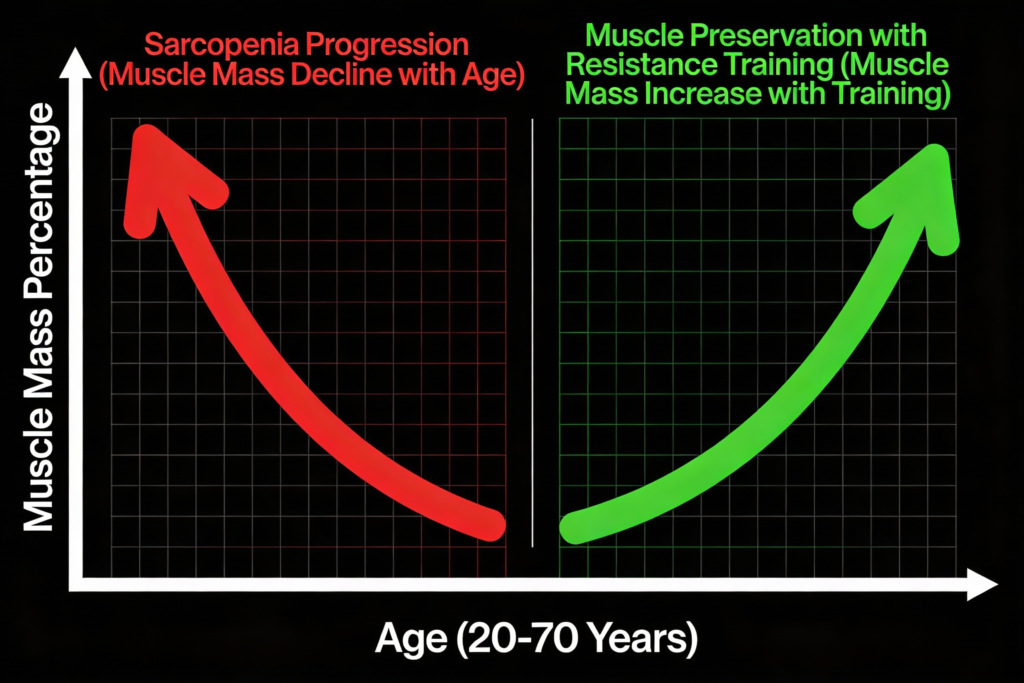
Sarcopenia progression vs muscle preservation through resistance training
Skeletal muscle is no longer viewed as merely aesthetic tissue. Emerging research recognizes muscle as a vital endocrine organ—one that regulates glucose disposal, modulates cytokine signaling, and acts as a buffer against chronic disease.
The clinical term gaining traction is “metabolic armor.” It refers to how sufficient muscle mass protects against sarcopenia (age-related muscle loss), which begins in your 30s and accelerates after 60.
The numbers are stark: your body loses 3-5% of muscle mass per decade starting at 30. By 60, that rate nearly doubles. Yet this is not inevitable. Progressive resistance training remains the only proven intervention to prevent and even reverse sarcopenia. A review of 121 clinical trials confirmed that resistance training improves not just strength but also gait speed and the ability to rise from a chair—two critical components of fall prevention and independence in aging.
Sarcopenia progression vs muscle preservation through resistance training
2. VO₂ Max as Your Longevity Metric
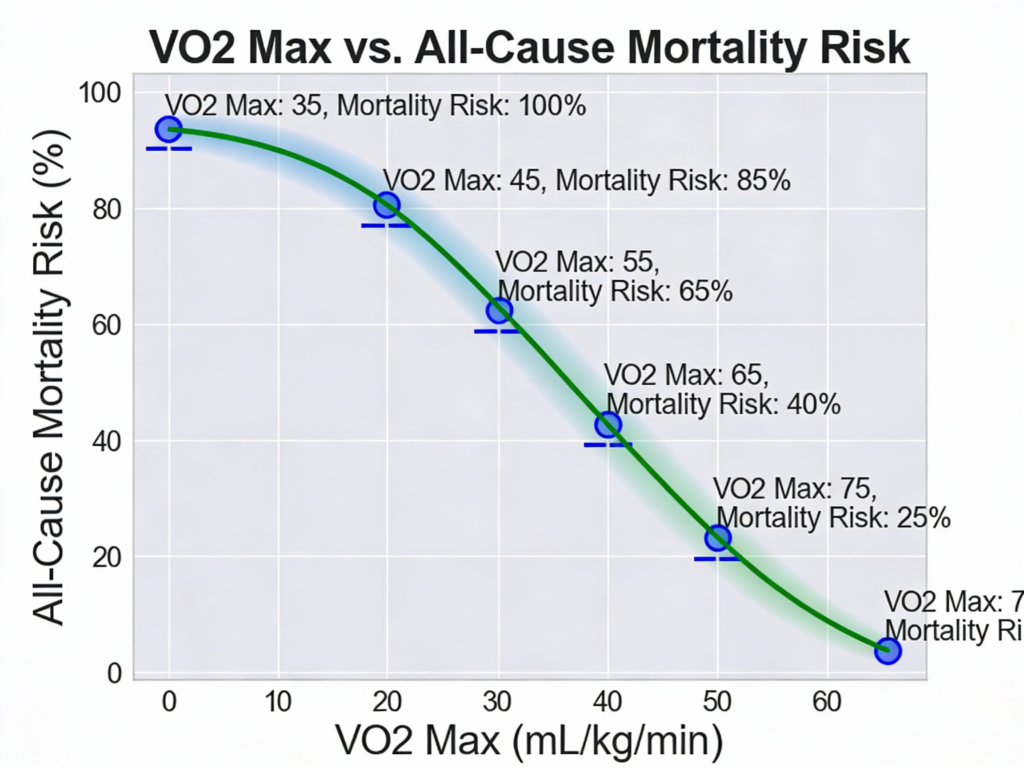
VO2 Max correlation with all-cause mortality risk – longevity predictor
If muscle is your defense against deterioration, aerobic capacity is your predictor of survival itself.
The data is sobering and consistent: VO₂ Max is one of the strongest predictors of all-cause mortality—stronger than smoking, diabetes, or hypertension.
The Cooper Institute Longitudinal Aerobics Study tracked over 80,000 adults across decades. Individuals in the top quartile for cardiorespiratory fitness had approximately 70% lower mortality risk compared to the lowest quartile. Even more striking: the difference between being “low” and “below average” represents a 50% reduction in mortality risk over a decade.
The dose-response relationship is quantifiable: every 1 MET increase in VO₂ Max (equivalent to 3.5 ml/kg/min) is associated with a 13-15% decrease in mortality risk, independent of age, BMI, or existing comorbidities. You can improve VO₂ Max by 3.5 ml/kg/min through structured aerobic training. That’s a 10-20% reduction in mortality—achievable, not theoretical.
VO2 Max correlation with all-cause mortality risk – longevity predictor
3. Mitochondrial Density: The Engine of Durability

Mitochondrial density and cellular energy production in trained muscle
The mechanism linking aerobic training to longevity is now mapped at the cellular level: mitochondrial adaptation.
Zone 2 cardio—steady-state aerobic work at 60-70% of maximum heart rate, the “conversational” pace—triggers a cascade of adaptations that optimizes cellular energy production:
- Increased mitochondrial density: More mitochondria per muscle fiber mean greater oxygen utilization capacity
- Enhanced enzymatic activity: Metabolic enzymes involved in ATP production increase
- Improved angiogenesis: New blood vessel formation delivers more oxygen to working muscle
- Greater myoglobin expression: More oxygen storage and transport within cells
This adaptation directly increases your capacity to sustain effort—walking a steep trail, maintaining posture during a long flight, recovering from illness.
The research is unambiguous: aerobic training activates the SIRT3/PGC-1α signaling pathway, promoting mitochondrial biogenesis and fusion. Strength training, by contrast, creates repeated metabolic challenges that also improve mitochondrial function, albeit through different mechanisms.
Together, they create metabolic redundancy.
Mitochondrial density and cellular energy production in trained muscle
Why Concurrent Training Actually Works Now

Zone 2 cardio on elliptical machine – steady aerobic training pace
The modern hybrid approach succeeds because we’ve solved the molecular problem.
Separation of stimulus: By strategically sequencing training and providing adequate recovery, you allow each adaptive signal to proceed. Strength training on Monday creates a hypertrophic stimulus. Zone 2 cardio on Wednesday, performed at low glycolytic intensity, doesn’t suppress that adaptation—it complements it.
Nutritional precision: Adequate protein intake (0.7-1 gram per pound of body weight) preserves the anabolic environment. When combined with sufficient total calories, muscle protein synthesis proceeds normally even in concurrent training. The key difference between 1995 and 2025 is that we now quantify and track this.
Periodization: Rather than running strength and cardio simultaneously at high intensity year-round, modern hybrid programs use mesocycles that shift emphasis. A 12-week block might emphasize strength and moderate aerobic volume. The next block might increase aerobic volume slightly while maintaining strength stimulus. This cyclical approach prevents the accumulation of fatigue that traditionally caused interference effects.
Training status matters: The interference effect is most pronounced in advanced athletes attempting to gain elite-level muscle mass while simultaneously improving elite-level endurance. For the general population and the “longevity athlete”—someone prioritizing health span, durability, and independence—concurrent training produces superior outcomes across all metrics: body composition, cardiovascular health, metabolic markers, and functional capacity.
Zone 2 cardio on elliptical machine – steady aerobic training pace
The Practical Protocol
The hybrid athlete protocol for the general population looks like this:
Weekly Structure
Strength Training: 3-4 days per week
Focus on compound movements (squats, deadlifts, pressing, pulling). Target 3-6 reps for power development and 6-12 reps for hypertrophy. Progressive overload remains primary. Total time: 45-60 minutes per session.
Aerobic Base: 150-200 minutes per week
Zone 2 cardio (60-70% max heart rate): 120-180 minutes spread across 3-5 sessions. Activities include steady cycling, running at conversational pace, rowing, swimming, elliptical machine, or brisk walking. Duration typically ranges from 30-60 minute sessions, but accumulated zone time matters more than session length.
High-Intensity Training: 1-2 sessions per week (optional, not mandatory)
15-20 minutes of interval work can replace one Zone 2 session and improves upper-end aerobic capacity (VO₂ Max training). This should not replace the base of Zone 2 work.
Flexibility and Nervous System Regulation: 2-3 sessions per week
Mobility work, yoga, stretching, or deliberate walking are crucial for recovery and injury prevention.
Implementation for Busy Professionals
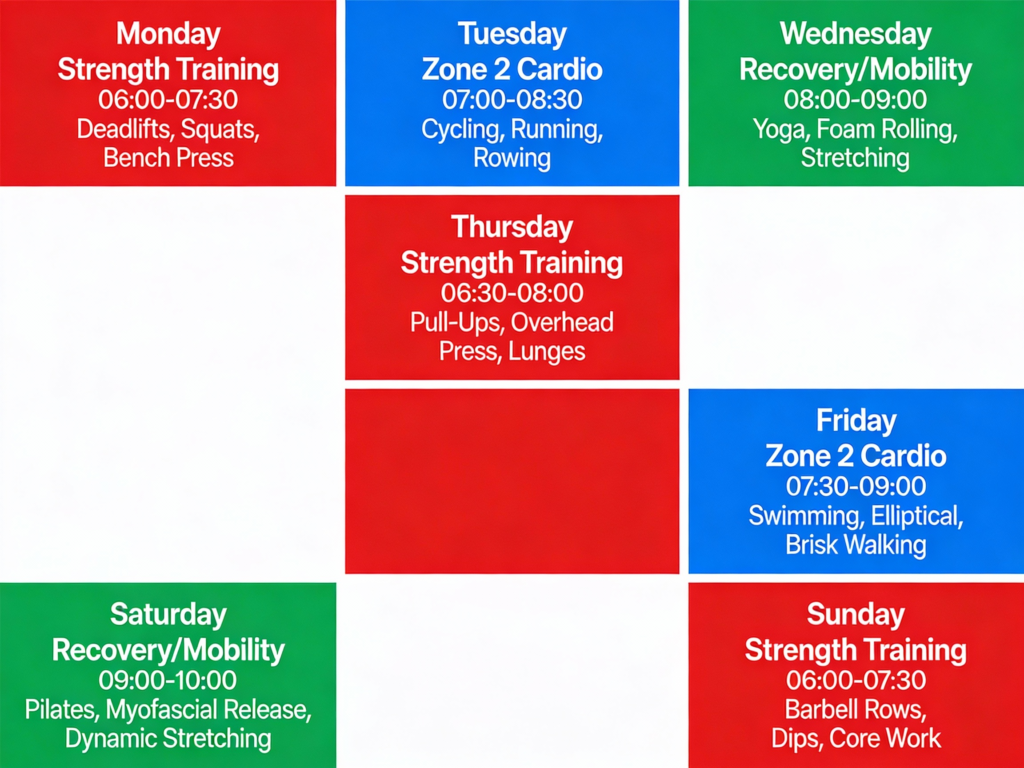
Weekly hybrid athlete training schedule and structure
A realistic template for someone with limited time:
| Day | Session | Details |
|---|---|---|
| 1 | Lower Body Strength + Zone 2 | 45 min strength (squats, deadlifts); 15 min easy cardio |
| 2 | Zone 2 Cardio | 40-60 min steady cycling, running, or rowing |
| 3 | Recovery | Yoga, mobility, or easy walking |
| 4 | Upper Body Strength + Zone 2 | 45 min strength (pressing, pulling); 15 min easy cardio |
| 5 | Zone 2 Cardio | 40-60 min steady state |
| 6 | Optional | Either 15-20 min intervals or 30 min easy movement |
| 7 | Rest | Complete recovery day |
Weekly hybrid athlete training schedule and structure
This structure accumulates roughly 150-160 minutes of Zone 2 aerobic work, maintains strength stimulus across two full-body sessions, preserves recovery, and fits within 8-10 hours of training per week.
For developers working from a desk, this protocol is especially valuable. The Zone 2 cardio can be performed on an elliptical machine or indoor bike during work breaks or evening hours without requiring specialized athletic equipment or facilities.
The Longevity Signal
The hybrid athlete protocol is fundamentally about signaling resilience to your body. You’re telling your physiology: “I can move heavy things. I can sustain effort. I recover well.”
Those signals—robust muscle, strong cardiovascular function, efficient mitochondria—are the same signals associated with independence in aging, resistance to chronic disease, and extended healthspan.
The evidence from 2026 is clear: this isn’t a compromise between two competing goals. It’s the optimal expression of one goal: durability.
Key Takeaways
The interference effect is manageable: Concurrent training attenuates muscle gains only when total workload exceeds recovery capacity or endurance volume becomes extreme (>10 hours/week).
VO₂ Max is a stronger longevity predictor than any medical risk factor: Each 1-MET improvement reduces all-cause mortality by 13-15%. This is achievable and measurable.
Zone 2 cardio is the base: The 60-70% max heart rate “conversational pace” zone builds mitochondrial density and aerobic capacity with low injury risk and excellent sustainability.
Muscle mass is protective tissue: Sarcopenia begins at 30 and accelerates at 60. Progressive resistance training is the only proven intervention to prevent it.
Sequencing and recovery matter more than total volume: Strategic separation of strength and aerobic stimuli, combined with adequate nutrition, allows both adaptations to proceed.
For the general population, concurrent training outperforms specialization: Blood pressure, metabolic markers, body composition, and functional capacity all improve more with concurrent training than with single-modality approaches.
The old debate is settled. In 2026, the question isn’t whether to combine strength and cardio. It’s how to structure them intelligently for your specific goals and recovery capacity. For most people, especially those prioritizing longevity and independence, the answer is the hybrid athlete protocol.
Your body is built for both. Train it like it is.